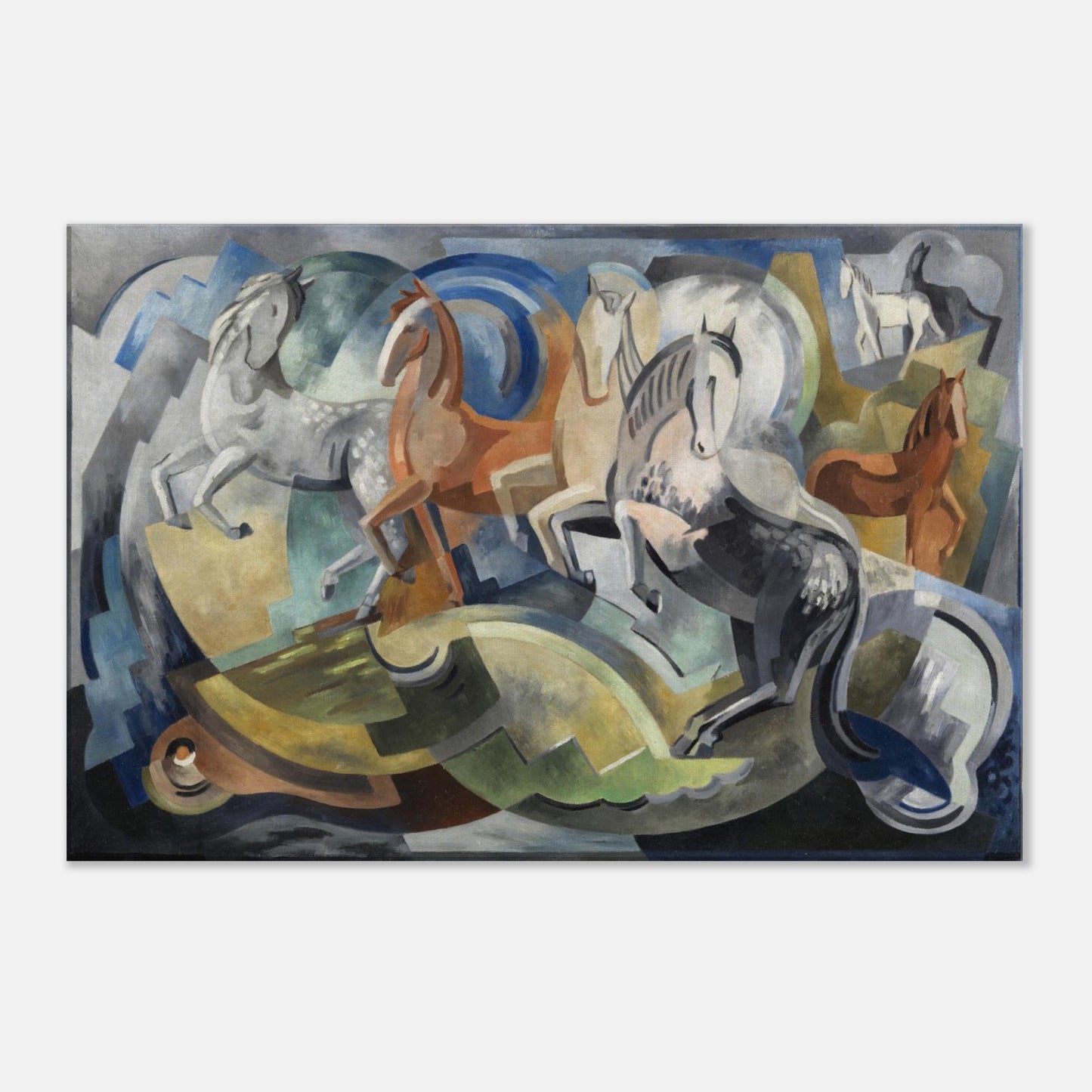
Achill Horses (1941) – Mainie Jellett Canvas Print
Achill Horses (1941) – Mainie Jellett Canvas Print
The original hangs in the National Gallery of Ireland, Dublin.
Couldn't load pickup availability
- Free Worldwide Shipping
- Ships in 2–5 Business Days
- 14-Day Returns
Achill Horses (1941) is among the most loved images in the National Gallery of Ireland. Painted after Jellett's encounter with Chinese art in London, it sets the horses of the west of Ireland into a rhythmic, semi-abstract structure - Cubist order fused with the dynamism of natural form.
Mainie Jellett (1897-1944) was a pioneer of Irish modernism. After studying in London and then in Paris under André Lhote and Albert Gleizes, she introduced Cubism and pure abstraction to Ireland, exhibited some of the first abstract paintings seen in the country, and helped found the Irish Exhibition of Living Art.
About the original
- Artist: Mainie Jellett (Irish, 1897–1944)
- Title: Achill Horses
- Date: 1941
- Medium: Oil on canvas
- Dimensions: 61 × 92 cm
- Signed on verso: M. Jellett 1941
- Collection: National Gallery of Ireland — bequeathed, Miss R. Kirkpatrick, 1978 (NGI.4320)
About this work
Achill Horses was painted by the Irish artist Mainie Jellett (1897–1944) in 1941. It is a semi-abstract composition of horses, the animals broken into overlapping geometric planes in the cubist manner she brought back from Paris. The original is oil on canvas, 61 × 92 cm, signed and dated on the reverse, and hangs in the National Gallery of Ireland (NGI.4320), bequeathed by Miss R. Kirkpatrick in 1978. Jellett painted more than one picture of this name — a separate Achill Horses dated 1938 is in private hands. This canvas print is an open edition, made to order and shipped worldwide.
Sizes & Format
- 60x90 cm / 24x36″
Canvas Details
Printed on artist-grade canvas and stretched on a slim wooden frame - arrives ready to hang.
Free Worldwide Shipping
Every order ships free, made to order and delivered from the hub closest to you: Ireland 3-7 business days, UK 4-8, USA 5-10, Canada 6-12, Australia 7-14.
Hangs well with
Gleizes taught Jellett a procedure rather than a style: translate a shape, rotate it, repeat. Each of these is that procedure run again.